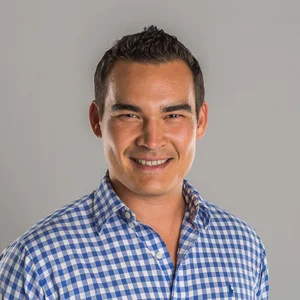
Official Caddying Story: David Simas
Watch a clip.
Then hear the full story.
David Simas: From Sankaty Head
to the West Wing.
On discipline, integrity, and the caddy master who taught him that your word is your bond — lessons that followed him from a foggy Nantucket golf course all the way to the Obama White House.
In this episode of Caddyshack to Corner Office, Kai Sato sits down with David Simas, an American lawyer and former government official currently serving as Managing Director of Research and Impact at Emerson Collective and a Fall 2025 Fellow at the USC Dornsife Center for the Political Future. He is best known for his senior roles in the Obama administration and his tenure leading the Obama Foundation, first as CEO and later as President, where he spearheaded efforts to establish the Obama Presidential Center in Chicago and develop global leadership programs.
Before that, Simas held several high-level positions in the White House under President Barack Obama, including Director of the Office of Political Strategy and Outreach, Director of Opinion Research for the 2012 re-election campaign, and Deputy Assistant to the President, where he worked closely with senior advisors David Axelrod and David Plouffe. Prior to his time in Washington, he served as Deputy Chief of Staff to Massachusetts Governor Deval Patrick. Simas began his career in his hometown of Taunton, Massachusetts, where he served on both the Taunton School Committee and the Taunton City Council.
The following transcript is AI-generated and has undergone only minor edits. Please refer to the video recording for direct quotes.
Kai Sato (00:02.03)
Welcome to Caddyshack to Corner Office, where we recognize the most accomplished people who once caddied and grow the game by assisting those following their path. I'm your host, Kai Sato, and today I'm lucky to be joined by David Simas. David, thanks for taking some.
David Simas (00:17.048)
Happy to join, okay, thanks for including me.
Kai Sato (00:19.704)
Before we poke and prod and learn about your early days looping, David, would you mind just telling us about what you do today, the ascent to this quote unquote, court of office, and what you've done kind of in your career to get you to this point?
David Simas (00:33.486)
Yeah, I, you probably hear this a lot, but I am the luckiest person I know. I'm so I'm a managing director for research and impact at the Emerson collective. And we're such a unique organization. There's like part VC, part media, part philanthropy, and
generally focused around viewing an intractable problem, whatever the case may be, around a series of different perspectives. What is the investment opportunity? What is the civic opportunity? What is the not-for-profit opportunity? Was it government opportunity? And so if you get people, my colleagues are like experts in all of these fields, but view things from a very different perspective. So my background in government and politics, I can look at a problem.
And the perspective that I bring is going to be very different than my colleague who's been in, know, VC for the past 20 to 30 years, or my other colleague who's been in philanthropy. And so it just provides this wonderful opportunity to look at hopefully the agreed upon problem, but then have a series of subject matter experts with different
perspectives, interrogate, kick the tires. so it's awesome. Prior to that, I was the founding CEO of the Barack Obama Foundation, a small startup on the South Side of Chicago. And then prior to that, I spent eight years in the Obama White House in different roles with the president. Prior to that, I was in Massachusetts politics, which is just the
best place to cut your teeth in the beauty of the American Republic and the democracy that we are. And two Portuguese immigrant parents who grew up in a fascistic dictatorship came over in 1968 to begin the American dream. And man, what a journey it has been for me.
Kai Sato (02:46.594)
Lucky indeed that is an incredible rap sheet David. If you wouldn't mind, tell us about your getting into politics. Why why politics? How did that start, especially in the great Commonwealth?
David Simas (02:52.696)
Yeah.
David Simas (02:59.192)
Yeah. The day that my parents became citizens in 1974, I like have a vivid memory of it because of how meaningful it was for them. Like, yeah, they came for opportunity, but the way my dad would talk about being an American citizen was just this point of pride and responsibility. He took
local elections and like who to vote for so seriously because he never had that opportunity. So I remember being a little kid and then later on my sister and having him just like kick the tires. We'd watch television or read the newspaper and he would always be saying, well, what did he mean by that? And what does he mean by this? And do they think about the consequences of that? And did they think about the consequences of this? And so it was like,
full perspective citizenship. And so my journey into it was in our hometown, politics was ethnic. And so the Portuguese were in ward three, the Irish were in ward four, the Polish were in ward five, the French Canadians, the Italians, the English whom we call the swamp Yankees. And so it was like this,
constant coalition building locally. And so it was like part sport, part civic relationships. And so I was just so drawn to that, given my dad's interest in democracy and politics, that I think I volunteered for my first campaign. was seven or eight. And then I ended up running for the local school board.
when I was 22. And then from that point on was this trajectory of local, county, state, and then federal engagement. So like at all four levels, my wife sometimes says that I belong in the political hack hall of fame just because of the, you know, the all four levels of engagement. And the interesting thing, Kai, is that
David Simas (05:26.03)
As I went up the different levels or as I just, maybe up is the wrong way to describe it, but I kept on thinking that, it's going to be very different between this and that and that. There were some differences. The biggest difference was just the number of zeros on the budget. But the human element was the same. Whether I was on the Taunton School Board,
Kai Sato (05:51.67)
Hmm.
David Simas (05:55.286)
or doing a meeting with a United States Senator who is interested in a piece of legislation, the topic was different. The human condition was the same. And that, for me, just in terms of the interaction, was one thing that was important. The other thing that was important, and it served me throughout my career, certainly in the Obama White House,
When I ran for that school board race back in 1993, I knocked on a couple of thousand doors. I did one side of the street. My mom would do the other side of the street. She was much better at it than I was. like, I was like, right, I had my 15 point plan and I'm gonna do this and I'm gonna do that. And no one wanted to talk about any of it.
to the extent they opened up the door and be like, okay, where do you live? So in their mind, what neighborhood is this kid from? Where do you go to school? Do you play sports? Where do your parents work? Do you go to church? And it was like this 30 seconds of like a political speed dating so that people were taking a measure of who I was. Because at the end of the day, that's
what it is, people don't have the time to dig into my 15 point plan. They want to take a measure of who is this guy? Like, what are his values? What does he care about? And you don't build trust at the door in a 30 second conversation, but it's like these initial kind of signals that you give people. And that too, every step of the way, was pretty much the same, which was amazing to observe.
Kai Sato (07:50.139)
I have a lot of questions about that, and it's not even the topic of our show, but I'm going to indulge myself a little bit. But 22 years old, 15 things, what did you most need to get accomplished? So I'm not surprised that your mom was a little more effective. It's very helpful when our mom is over there teeing up some of those passes. And I'm not surprised that there was a lot of pre-screening, especially in Massachusetts area, where wards and religions and countries of origin really matter.
David Simas (07:56.203)
Yeah, yeah.
David Simas (08:18.625)
Yeah, yeah, they do.
Kai Sato (08:19.768)
My best friend's from Boston. He's actually Boston Fire still and a former Marine. So I spent a lot of time out there and I know how edgy you can get. But as you think back to that 22-year-old, what was that like? Not surprised that the human condition is the same, but what was so important to you? What were you called to do? What were you drawn to do? How do you kind of feel about that as you reflect as a 22-year-old?
David Simas (08:24.461)
amazing.
Yeah.
David Simas (08:43.559)
Yeah, so the Race for School Board just flowed from the primacy that my parents put on education. they, the two of them in Portugal, it's called Quarta Classe, it's fourth grade. It's different than in the United States. But for them growing up in the late 50s, early 60s, literally their formal education ended at the age of 11.
Kai Sato (09:09.07)
Hmm.
David Simas (09:10.643)
but what you crammed in.
in those short years. And so for them, they worked in factories and they worked hard. My mother lost two fingers in a factory accident. My dad, you know, had like some injuries also. Never once did I hear either one of them complain about their, the plight that they were facing because they had a job to do. They left everything behind so they could build a life for the children they didn't even have yet.
when they came, that was better than theirs. And the key for them then was just education. It's like you learn everything. But the piece of education that was really important, and I've reflected on this a lot more now that I am a 56 year old with two children of my own, 27 and 20, was that for them education, yes, it was important that reading, writing, arithmetic and
basics of developing your cognitive skills. But there it gets back to the citizenship part, where in order to be a citizen, and to fully engage with all of that, what that brings, is a critical thinking skill. There is a socialization skill.
among a variety of different people from disparate backgrounds. And so in the classroom, that's the first time really that this citizen in training learns how to begin to mediate difference. Right? there was, for me, that was magic. And I was given so much because of their hard work. And so that's what I wanted to do.
Kai Sato (10:49.55)
Hmm.
David Simas (11:12.544)
in run for office. So that's one piece. The other piece was I envisioned a political career. Like it's something that I wanted to do. I wanted to be a lawyer. I wanted to go into politics. Law because of my mother's accident and her lawyer became like my hero. Guy was like five foot four, five foot three at the most. But to me, he was like, he was a giant. And I'm like, that's, I want that. And so that race,
Kai Sato (11:29.029)
Hmm.
David Simas (11:41.645)
to run for school board was the beginning of the political piece. And I was going to law school at the same time and had just left seven years at Camp Sankaty Head on a little atoll in the Atlantic Ocean off the coast of Cape Cod.
Kai Sato (12:00.538)
promise we were going to get there. The one thing I'll say before we now dive into the caddying, I am the son of a Japanese immigrant father and an educator on my mother's side. She taught at Arizona State and at Thunderbird. grew up in the classroom. And so a lot of the things that you touch on, I was not raised in a household where politics and that say really mattered as much. It was something that kind of entered my life later. But these multitude of perspectives that you touch on now at your work at Emerson, but even the beauty and diversity.
right, and understanding that there are these different places from which people come. And hopefully many Americans can leave at some point in time and then come back and appreciate these different perspectives like I was fortunate to do as a young kid going to Japan. But no, those things, think, where else in the world can you not only have a say, but you can do something about it, right, that you can take office. And so I would say you very much much like a Major League Baseball player, you you earned your stripes. And I would not necessarily moving up, but just
moving in a progression. I think some people want to stay local, and that's fine. But if you're called to the highest office and in what shape or form, mean, the beauty of this country is that you can do it. So caddying, obviously why we're here. Where'd you caddy? You alluded, we've got some real golf heads that listen to this. where'd you caddy? How old were you? How'd this thing get started?
David Simas (13:00.063)
Yeah
David Simas (13:14.783)
David Simas (13:20.06)
I caddied at the most amazing place, caddy experience on the planet, in my opinion. was at Camp Sankaty Head in Sconset on the far eastern windswept, foggy coast of Nantucket, right in the shadow of the Sankaty Head lighthouse. I was 16. There was a middle school teacher, Mrs. Mary Butler.
who had a connection with a camp director, guy named Doug Ellsworth, who subsequently became my best man at my wedding a few years after that. And there were 50 guys. Someone had left, so they had an opening. And so I went basically at the end of the summer in 1986. I took the ferry from Hyannis to Nantucket.
I'd never been to Nantucket. I'd heard a lot about it. It was a horrible storm, the way those things kick up sometimes in the late summer in New England. And greeted at the old Atlantic and Pacific grocery store by a guy driving a beat up, like 1979, station wagon with four
guys from Sagas and Weymouth and other places in Massachusetts who looked tough. I had never been on a golf course. I had no friggin clue what I was doing, why I was doing it, except I was 16. I wanted to get away. I wanted to go to the beach. And kayas were pulling down this dirt road into where the Katta camp still is.
I think it's probably celebrated over 100 years in operation. I see at the time there were these marine Quonset huts. And so they are aluminum half shells. And there were four of them. Two of them had 12 bunk beds, six on each side. So there are 50, enough room for 50 guys.
Kai Sato (15:41.991)
you you
David Simas (15:43.221)
One was the rec hall, which was divided two thirds rec, one third was for senior staff. And then the fourth Quonset hut was the mess hall, where we had one of the older guys was the cook and one of the younger guys was the mess cook. And then there were these, there was just one kind of bathroom facility. And so, I mean, it was like showers open.
no stalls. And so I'm like, my God, where the hell am I? The next morning, so like I end up on the top bunk in the middle of Hut 2 with this guy who didn't even want to look at me because he had to like help train me and and I had bad eyesight, which is suboptimal for a caddy. So I had to like wear some really thick glasses too.
Kai Sato (16:14.152)
You
David Simas (16:41.324)
And it's like always foggy in the morning. So all of a sudden, like first morning, I think it was at 7.15, I'm gonna get this wrong, but for purposes of our discussion, all of a sudden you hear what sounds like a trumpet and everyone now grabs their towels, runs in. I'm like, why is everyone running?
Kai Sato (17:06.874)
you
David Simas (17:09.062)
what's going on? it's like by the, because the water, you run out of hot water pretty quickly. And so then you come in and there were two aluminum lockers right near the one bunk bed. And then it was time for inspection. And so you had 15 minutes to get your shower. Then you came in, you had to make your bed. And then you had to make sure that all of the folds
on your clothes in the locker had folds out and they were all lined up and that there was no sand either on the floor or on the bed. And I'm like, OK, fine. And then you stand, literally you stand at attention. Now this is the way it used to be. You stand at attention by the sign of bunk while one of the senior staff members for that day comes in and does inspection. Inspection is they look at your, we have
gray, our catting shirts were gray and they had the Sankaty Head logo on it. So you had your gray Sankaty on. Was it washed? Did it have holes in it? So they check you out first. Then they check the lockers to make sure. And then they check for contraband also, just see what the 16, 17 and 18 year old boys are doing. And then every like second or third bed, but you never know which one, they literally then
put their hand between the blanket and the sheet to make sure that there's no sand. If there are infractions, there was a point off for infraction. So shirt untucked, one point. Fold on your locker, two points, maybe three points. Sand, that's four points. Each section began with 60 cumulatively, and if you got below 50, so if you lost 10 points, then there was group punishment.
for that section, which was usually, okay, Thursday and Saturday night was Liberty. It's when you could head into Sconset or downtown. And so instead of having Liberty, you would maybe have one or two hours off. And so there was this kind of team effort to make sure that you didn't screw up and everyone was in line. And so that's even before I grabbed a bag to begin to sew. It was...
David Simas (19:38.623)
Wild.
Kai Sato (19:40.346)
So how badly did you want to leave on that first day?
David Simas (19:43.531)
Pretty bad, pretty, but like there were no cell phones. And so like you write letters. Yes.
Kai Sato (19:45.348)
So.
Kai Sato (19:49.235)
you're there. You're there. You're trapped. You're trapped. So how does this thing progress? You've never caddied. And they do some training, I believe. And quick segue, people don't know. Sankaty Head is this historic place. It's actually Jack Welsh was a big benefactor, former caddy himself, and did a lot to further that. He was part of the reason we started Caddyshaft Corner Office, because when I found out he caddied and then he passed away, unfortunately, I was like, wow, what a cool story.
David Simas (20:09.963)
Yeah.
Kai Sato (20:18.394)
Same with John Madden. These stories like yours are so cool. And so we wanted to delve in. And so Sankaty Head is always revered and held in high regard. And we have a lot of alums that are following along right now. So what was this onboarding experience, if you will? mean, you're cold shower. You've barely survived morning inspection. And how do they start to get you assimilated into the Catechord?
David Simas (20:45.899)
Yeah. um, uh, grab my, grab my Coke bottle glasses since my, had to buy saline solution for my contacts. I didn't have it. And so I was trained by the Cali. Like what, what? It's a caddy master. Like that's a weird title. And there was this huge dude from New Jersey. He was huge to me, but it's like a normal guy, right? Corey. Um, I think it was Corey Hughes.
and his brother helped to train me. was, Kai, he was so patient. I'm like, I was so lucky that this guy helped to train me. And as you know, it's a links course. And so like the grass all along the edges of the fairway, it's like, you know, it's like a foot of like Nantucket.
grass and the wind, and the wind, especially when you get on the front nine, which goes right along the cliff overlooking the Atlantic Ocean and like the fourth and fifth hole, there's the amazing Sankaty headlight. And so he took me out, he took me out early in the morning because we wanted to be out to train me before
Kai Sato (21:45.604)
You can lose a golf ball in there. Yeah.
David Simas (22:10.879)
The rounds began. There were always some members who were out super early, but he took me out. And that was my first introduction to Nantucket Fog. Kai, you can't see a thing.
Kai Sato (22:22.714)
Especially not you.
David Simas (22:25.435)
especially not me. so, so he's like, he's trying to teach me how to like follow the ball. And I'm like, dude.
Kai Sato (22:35.61)
I mean, does he is a one bag to start as he tell you to stand here? mean, what was what were they even attempting to do?
David Simas (22:43.123)
Yeah, was for the first few holes was one bag and then they did the two and he's teaching me positioning where I stand, a good way to follow the trajectory of the ball and the very specific hints about the roll into the tall grass on different parts of the course.
just to kind of learn that. I'm like taking notes and trying to remember everything. But fundamentally, I'm like, I can't see. I just can't see. So it's like, don't worry about it. You'll pick it up. So I did that the very next morning. I had.
David Simas (23:29.446)
singles, had 18 singles and I'm probably misremembering if this was the first day or the second day. Because the member, I mean he was really nice, but like the dude, and rarely did anybody use a golf cart.
Kai Sato (23:38.084)
We'll let it slide.
David Simas (23:50.257)
So this one guy was almost like sprinting. So he'd hit, he'd go and he'd be like double timing it. And I'm like, and I was making so much noise. So it became my way of caddying where I would not have the strap over my shoulder. I literally just grabbed it like suitcases so that I could keep up with a dude. And it became like, actually this is easier and it was much better to do. I picked it up. right.
And he turned to me and he's like, what do think I should use?
David Simas (24:31.366)
a club, right? Right? And he's like, all right, right. Like, there are some of the older caddies who'd been there a couple of summers who could do that. The rest of us, we just, and they knew it because there's a scholarship. And so this wasn't about necessarily the training of folks in the art, the work, even the game.
Kai Sato (24:32.442)
The big one?
David Simas (25:01.2)
but about giving some teenage boys an opportunity to make some money, learn how to be away from home for summer. I eventually got to the point where I could, like, never became a golfer because I was terrible because of my baseball swing. I got to the point where if a member's like, hey, David, four or five, and I'm like, four if you hit it right.
Always my hedge.
Kai Sato (25:28.474)
Well, look, some plausible deniability. What did your family think, say about this whole excursion?
David Simas (25:34.111)
Yeah.
David Simas (25:41.715)
My dad wanted to know, because room and board was $5 a day. So for $35 a week, you got to live with a bunch of guys. And so for him, he wanted to know how much money I was saving. Was I budgeting? Did I calculate how much money? So it was all like the, this is the first time that I'm.
own and to try to understand for me to understand the so much coming in. How much did you spend this week or today? And so that was for him. My mom, she she missed her. She missed her son. But you know, within a couple of weeks, you're doing it's now mid August, it's hot, it's Nantucket. So it's not scorching hot. But like all of us are doing, you know, 36 holes.
We're all doing doubles. So you're out on the course eight, nine hours, 36 holes, doubles. And like on a good day, you you subtract your $5 a day room and board. And I forget what the rate was for doubles, but like I was clearing 40, 45 bucks a day, which for a 16 year old, no.
Kai Sato (26:59.919)
And have you ever made money like that? Yeah, this was real money all of sudden.
David Simas (27:04.968)
real money all of a sudden. And it's so interesting you mentioned Mr. Welch. Cause I would caddy, I caddied for him not frequently because he required because of the type of golfer he was. And he would request one of the older kids, but every once in a while, especially in my second and third summer there, I would caddy for him. And I remember he asked me what I wanted to do.
And I said, I wanted to be a lawyer. And he's like, it's too bad. It's like, that's just what the world needs, more lawyers. Why do you want to do that? What's wrong with you? It's like Jack Welch, right? And then for some reason, politics came up. I said to him, somehow it came up that my dad, so my dad was a Republican, very,
conservative Republican, my mother was Lee Moore Democrat. And he was like, well, your dad is smart. And you he just proceeded to like tear apart Michael Dukakis and Jesse Jackson, and like went off. The thing I observed about him, which is one of the wonderful things about, and it goes to what I was saying about politics and kind of what I learned.
There's this like I'm now 16, 17 years of old, a son of immigrants. The game was interesting, but the interaction between the two golfers or the foursome, conversations about business and just the different approaches and the different attitudes and the different styles that people have. Like from a perspective,
from my perspective, an insight into a world I couldn't even have imagined. There were instances where Larry Bossidy, another kind of famous CEO, was talking about a deal. And I remember not the details, but it was very little about the math of the deal. But it was about the team.
Kai Sato (29:15.623)
Sure.
David Simas (29:30.682)
And it was like, my assumption was that business people, like the math is everything, but it was like, who are the leaders? What's the team? And going out to dinner with them and lunch with them and bringing them through to kind of, and like, you're just absorbing all of this in like just the most amazing class. Yeah.
Kai Sato (29:54.009)
That's incredible. That's it. mean, as you get further along in anything, whether you're doing at Emerson, what I do in my day job investing in growing companies and private equity, it's people, right? The math is pretty simple. It's pretty basic arithmetic. But it all comes down to people, locker room, and Larry Vosadieff. Not surprising, actually, a mentor of one of our earliest guests, Mary Petrovich, who is deeply involved with the Evans Scholars Foundation.
David Simas (30:05.514)
Yeah. Yeah.
Kai Sato (30:20.542)
and was a life changing figure in her life. So was Lou Gerstner Jr. So but you touch on this dynamic and here's a kid from Mass 16 years old winds up. You can't even fathom the Lord of the Flyers dynamic of showing up not knowing how to caddy, not even a golfer. Can you talk about that assimilation process? Sounds like you figure that out. But then you're out on the course and every day it's so different, right? Because
You don't know who's going to be in the group. You don't know who you're looping with. And so that in and of itself, there's teamwork involved. Are you helping each other? You're not. Are you raking bugger so when somebody can't be there, are you cleaning balls? And then at the same time, are you making sure that they are having a great time? And then you don't know. Is it Larry with an M &A opportunity? Is it just Jack Welsh and his crew? And not surprising, he was a bit exacting and wanted certain things. But can you touch on, it seems like you picked it up pretty quickly, David.
David Simas (30:58.547)
Yeah, yes.
David Simas (31:09.672)
Yeah.
BLEEEH
Kai Sato (31:17.592)
What was that like if we were to paint this montage of you that first year and even as you started to gain your footing in the ensuing summers? When did you know you had it down and what were some of these other kind of stories, takeaways that you can recall?
David Simas (31:31.113)
Yeah, yeah. I caddied. So that first summer, which ended up being four weeks was just a fire hose of, you know, like when you're learning anything, you just, for me, observe, observe, observe, watch the guys who are really good or the perception is if they're really good. I'm like, do that. Ask them.
Like, why'd you do that? Why didn't you do this? Et cetera. And like basics, like, hey, man, learn the rules first. Like, like, don't touch the ball. okay. Don't touch the ball. Don't touch the ball. Repeat over and over again. Don't stand there. Yeah, don't stand there because you're going to get hit.
Kai Sato (32:17.37)
An important one.
David Simas (32:23.241)
You know, and so there was a there was a lot of that terms of the members. This is where my volunteering on engaging in politics early, early as a kid helped.
David Simas (32:42.577)
Not that I got good at it, but I had some pattern recognition around the way adults engage with one another. The circumstances are different, but the dynamics of who's talking, what type of conversation is it? And you just kind of know based upon are these old friends. And if they're old friends, it's a different job.
Kai Sato (32:49.626)
Hmm.
David Simas (33:11.259)
if they're meeting for the first time and you're that person's caddy.
there's a cadence, there's an expectation. like you would, you would, I would try to figure that out very, very quickly. And, and something that I think has stuck with me to this day is ask the member, especially if I've not caddied for him before upfront, like expectations, like, what do you like? What, don't you like? I'm new here. And sometimes you're really like, God, fine. I got to train this one too.
Kai Sato (33:34.511)
Hmm.
Kai Sato (33:44.622)
Right.
David Simas (33:45.797)
And the caddy master was also really, really good about making sure because he needed to make sure also for himself.
Kai Sato (33:53.444)
Talk about a general manager job. That's a tough, tough alchemy to get right.
David Simas (33:57.768)
Yeah, right. He'd look down the, he'd look down the bench of us misfits. like, no, not you. You go, right? Like, come on, man, really again. And so, so there was all that stuff in the banter between the Lord of the flies stuff, because the camp was divided into four teams. And so as the huts two teams per HUD.
Kai Sato (34:11.108)
You
David Simas (34:27.305)
two huts. And so all of the sports, your Liberty parties, everything that you did was around these teams. And the team had a captain and a co-captain and a vice captain or assistant captain or whatever the case may be. And so it was like a Hogwarts type of mentality also. We're like, you were constantly ragging on the other team. And so there was that.
But the grown-up piece, for some ways, me, Kai, in some ways was easier than getting thrown in with the guys whom I didn't know, and a lot of them had been there for a while, given the fact that couldn't see.
Kai Sato (35:14.138)
They just had to tolerate a blind caddy. That doesn't surprise me at all. just chatting with you now, were there any kind of regular loops or people who you really gravitated toward, took you under their wing? Anybody who stands out in that regard?
David Simas (35:31.209)
Yeah, he was, his name was Michael O'Reilly. And he was a six foot four or five Irishman who owned a couple of hotels, small bed and breakfast and inns on Nantucket and a bar or two. And that guy, Kai, was the kindest, most patient. He took a shine to me.
immediately. He loved the way I would like run down the course carrying the bags. And like he would, yeah, he'd like, right, he'd turn to like the guy with him in his Irish brogue and he's like, watch this. I'm hauling ass down and like the other poor caddie is like, dude, why are you running? I'm like,
Kai Sato (36:11.214)
With your patented move. They know Seamus. There he goes.
David Simas (36:28.787)
"'cause it's gonna take me a beat to find the ball." Right, right? So that's the way I adapted. was like to get there a good 15 to 20 seconds before anybody else. But like O'Reilly turned that into like, it was bizarre. like, he'd end up requesting me. like, Mr. O'Reilly, I'm not good at this. Like what he's probably saying, yeah, but you're funny.
Kai Sato (36:32.932)
Yeah, I gotta feel around in the dark, guys. I'm legally blind.
David Simas (36:58.537)
He was, and he would request me for member guest tournament.
Kai Sato (37:04.058)
Right. Those are fun. What was that like at Sankaty Head? mean, I would imagine there were some big ones during the summer that's kind of the Super Bowl for anyone who hasn't done it before. You actually get some, usually some pretty good food as a caddy, and so there's some real benefits, maybe stuffing some cookies in your pocket.
David Simas (37:13.63)
Yeah.
Yeah, yeah.
Yeah. Yeah. He got a lot of cookies in the pocket. Yeah. The member guest was the big event. Besides the caddy banquet at the end, which for all of us with the main members in the clubhouse, that was the end of summer for the guys. But the member guest, I only did the member guest with Mr. O'Reilly per his request for all of the years that I was there.
And while he was competitive, like he wasn't competitive like the top guys who were like always competing hardcore and in the club championship. I remember, I forget who the other guy was, but one of the golfers was a guy named Jacques Wulschlager. And it came down to like a playoff overlooking the, and they were coming down to 13th.
which is where the caddy camp is. And like all of a sudden there are like people following and you've got like 50 caddies all lined up and watching. it, for me, I'm like, this is like so intense. These two dudes like going at it for hours in both a physical, but it was one of those moments where you appreciate the mental aspect, especially the mental aspect of the game.
Kai Sato (38:49.949)
Particularly in match play. Yeah. Yeah. Yeah. Absolutely. Was there any sorry, go ahead. Go any any any wagering going on? I would imagine, especially if this this match is coming down the stretch and it happens to be on full display right in front of the the caddy barracks. I imagine there had to be some of those rations being put back and forth if I know a caddy yard at all.
David Simas (38:49.959)
in the back and forth. It's particularly much, yeah. The other, but, I don't know.
David Simas (39:12.776)
Yeah, there's the caddy bank was open twice a day morning and after after dinner. And so I remember the withdrawals on the morning of club championship are always pretty intense. I'm like,
Kai Sato (39:33.102)
That was a crescendo. That makes sense. That makes sense. I'd be disappointed if it wasn't. But guess what? That's a good lesson and it's not that expensive, relatively speaking.
David Simas (39:41.384)
Yeah.
David Simas (39:45.532)
Yeah.
Kai Sato (39:47.994)
Sorry, were you gonna say? Before I pull you further down this cattying path?
David Simas (39:51.344)
No, no, no, there was this moment where
Bryant Gumbel was someone's guest. And it was the first time I'd ever seen an African-American playing at Sankaty Head. No, we had some African-American caddies, we had some Hispanic caddies. And it was just like a different era also. But I remember that was singular.
Kai Sato (40:11.087)
Wow.
David Simas (40:28.584)
Not that anybody was saying anything, right? But it was, you know, you could, it was a different vibe that day because he was there, he was famous, but it was, it was in some ways really seamless. So this is like 1987, 1988. you know, again, it was just a.
different, almost 40 years ago, Kai. That was a different world entirely.
Kai Sato (40:59.251)
Sure, especially that slice of this country at that point in time. It truly still is in some respects. But but I would imagine that that was going to be a head turner and I would imagine pretty inspiring for some kids to.
David Simas (41:14.024)
Yeah, it was, especially for, you know, we had a couple of the, a couple of the guy, one guy comes to mind from Newark who, you know, like he couldn't believe that there was a black man on the course at Sankaty Head. And it was, it was pretty good, but like the camp director Doug Ellsworth,
Kai Sato (41:30.105)
Right.
Kai Sato (41:34.607)
Right.
David Simas (41:40.914)
Kai, that guy, God rest his soul, he died a couple of years ago. He had inherited the leadership of the camp from his adopted father, a guy named Norman Claxton. Norman Claxton was a World War II Navy hero. And so I learned afterwards all of that inspection protocol and the discipline and everything that went into it.
came from Norm's Navy Annapolis training. And at the time we all bristled, but you know, in retrospect, you've got 50 guys on Nantucket Island unsupervised. If you don't establish like for an overnight camp all summer long, and the camp was an eight to nine week.
experience. You're not like there for a few days. You're like there. And so the cultures are developed. In the mindset, if you don't instill a sense of order and discipline in systems upfront, you're going to have chaos very, very quickly.
Kai Sato (42:51.322)
Sure.
Kai Sato (42:57.284)
Can you elaborate a little bit? This man stood in your wedding as your best man. Can you talk about one of the questions you always know is some of the people from whom you caddied, how did they factor into your life? And it wasn't necessarily someone that you caddied for, but what was that relationship like? I would imagine that he was rather big in a lot of former caddies' lives, especially around sankaty. But just can you elaborate on that story and yours?
David Simas (43:21.848)
Yeah, Doug. Doug was the most loyal person I ever met in my life. His word was his bond is like one of these guys. If he says X, X will happen. If he can't guarantee X. And he was really precise. And he's like, he would he wouldn't fudge he would
He would say it, right? It's like, I'm gonna do my best. I can't guarantee it. Right? And so just that, the importance that he put on his word, right? Was just the thing that totally stood out. When he would go to bat, cause you can imagine there were tensions between the Townies and the Caddies. And like, there were two universes of Townies. There was like the Nantucket.
year round who had fewer problems with the caddies. And then there were the kids who summered on Nantucket. And there was plenty of tension there. Doug was so fierce, even if it was a member's child.
And that's the thing, like there was one day where there was some tension between one of the members' kids and one of our guys. And Doug called the guy in, our guy, what happened? And then called a couple of others who saw what happened after the guy left. And I'm like, separately, what happened? So he's triangulating around the truth. He got a comfort level of what the truth was. And in this case, our guy was fine.
We could be knuckleheads, but that day our guy was not the primary knucklehead. It was the members kit.
David Simas (45:22.567)
So Doug, instead of waiting for the member to come down, went to the member just to, let's clear the air. And from what I heard, I wasn't there. I was like, here's what happened. My guy's good. If you got a problem, you let me know. And it was fearless. But the lesson...
that it showed the guys around truth.
Right? Cause that's what he did first is like, what is true here? What happened? Because if our guy had been the knucklehead.
He would have said, you screwed up. He would have been more explicit about the words he used about what the guy did. And he would have apologized on behalf of the camp to the member. That mean it was just... And so those qualities were just so attractive. And I became his assistant camp director.
Kai Sato (46:18.234)
Thank
Kai Sato (46:28.259)
Hmm.
David Simas (46:33.467)
that he brought me in. so my act of caddying was only about a year and a half. He put me on staff. And then for the final five years there, would only caddy member guest maybe one other time or two other times. Mr. O'Reilly needed a laugh. He would have me head out. And rest of time I ran the camp and made sure that the 50 misfits from all around the country did their job.
Do your job. Learn a little bit about what it is to be a human with some independence for the first time in your life. Don't do crazy stuff to yourself or to others, especially at the beach and especially during Liberty involving some of the young women of Nantucket. And then have fun.
Kai Sato (47:30.458)
So you spent five years. It wasn't just going and looping 16, 17, 18. Then you quickly moved into management, kept getting promoted, seems to be a common theme. And then you got the inmates running the asylum here. And so what was the management piece like for you?
David Simas (47:50.463)
establishing what my, like the mistakes I made when I, I think all new leaders into a role, when you, especially when you first assume a role, like who am I? Like, what is my style? What, and like, I'm trying to borrow from different people, but it doesn't fit, right? And so like that first year was seeing,
how I manifested my leadership and not just with the caddies, but then with my staff, two different types of leadership and engagement. And for me, the big moment was every Sunday night after dinner, we would have a camp meeting in the mess hall. And that was both a reflection on what just happened that week.
and also the preview of where we're going. I felt most comfortable in that role, the retrospective, and then the here's where we're going and learned about other people who worked with me on the team were much better at these other pieces of the job. And because Doug was always there, he's like, hey man, you're good at this, but you're not good at that. So why don't you let...
Joe or Paul or whomever else do that piece. And at first, guess I want to do it all like, No, I'm in charge. I'm gonna do it. Right. And what so
Kai Sato (49:29.314)
Of course, of course. You meant you mentioned Doug, though, and there tends to be a common theme, but there's almost always this figure that is of the utmost integrity. And it's not always a caddy master. guy that I talk about on this show is a dear friend of mine named New York Mike. And Mike taught me how to caddy. I don't get intimidated easily. He used to terrify me. He was he was the top dog in the yard and you knew it. But you would never I called him boss one time. He ripped my head off. He's like, no.
I'm just like you, everybody else. as I've been able to, I've been a member at Bel Air for 13 years now and still get to spend a lot of time with Mike and he commands more respect, not just amongst the caddies, amongst the membership. He has more pull than most of the members and he should because if Mike's doing something, he's doing it for a reason and it's the right thing to do. And there are just those people that you find and they're your North Star and somewhat similarly, I think, I grew up a lot of my life without my dad around, so I've had so many mentors.
David Simas (50:27.066)
Yeah.
Kai Sato (50:27.642)
you have to find your own style. it sounds like you did because imitation is suicide, right? So it's all a matter of what is authentically you. And if you can start there, then you have some chance at hopefully coming across in a real way. so whether it was sports and subsequently politics, but even little things like earning that call job as a caddy. And now all of a sudden, you're training or you're deciding sometimes
David Simas (50:40.357)
Yeah, yeah.
Kai Sato (50:53.922)
a grown ass man gets this job and this other guy doesn't. And you've got to wear that, right? It's your call, and you've got to make that decision. And those are going to be recurring themes in your life. And so if you can get that under your belt when you're 16 to 21, you tend to have, yeah, yeah, yeah. they certainly didn't endow a weekend caddy like me with too much responsibility. you were really running a show.
David Simas (50:55.525)
Yeah.
Yeah, that's right.
David Simas (51:08.198)
Yeah, it's a gift. It was a gift.
David Simas (51:16.752)
You
Kai Sato (51:20.074)
And it seems as though I didn't even know the extent that it was such a transformative experience in your life. And I would imagine as you moved right into 22 years old, kind of running for this first figure and getting your law degree, it was just a culmination of what you just done, but this recurring theme in your life, David, of how do we build consensus? How do we get the best and the most talented, but multitude of perspectives in the room and then
How do we as a group and as a people try to move forward the best that we can? And we may make mistakes, at end of the day, are we trying to do right by our citizens?
David Simas (51:57.582)
Yeah, 100%. And Kai, you know, in anticipation of this time with you, and how annoying I've been to my daughters.
is like, they're like the basics. That's that even some days are hard for grownups. Make your bed.
your stuff away.
Kai Sato (52:24.568)
Yeah, well, we we always like to know and it's sounds like some people were deeply impactful. What what is one thing you say to your daughters would say twenty seven and twenty? If you think about, hey, dad was a caddy and kind of ran a really special place for a number of years. What was that big learning that you took forward and you moved, you know, into fatherhood, into your career? If you could distill it, is there one?
David Simas (52:51.75)
Yeah, there isn't one. You know, because it's hard to disaggregate chi, the different elements that you pick up. But like they're in reflection. are those, like learning to take care of myself and not having, and not depending upon anyone else to do those things that I can do.
Kai Sato (53:17.806)
Right. Right.
David Simas (53:19.92)
Very very important.
David Simas (53:28.1)
Are you still there?
Kai Sato (53:30.074)
I think you're back. Yeah, we've got we'll get that part edited out. But no, like you said, learning to take care of yourself and you left when you're 16 years old and you finish up with this tour of duty at 21 and you're a man. You're running not only your own P &L, but you're making sure that the right people in the right positions, they're being disciplined, trying to pair up caddies with the right groups. All of that type of stuff is is absolutely essential. As you I will let you hop here in a second. We'll take up your entire day, David. And it's been a real pleasure. But how do you
David Simas (53:56.164)
Yeah, likewise.
Kai Sato (53:59.895)
as you move forward, you you move into politics and you do some very unique things. You think about Brian Gumbel and maybe some African-American kids seeing someone on a golf course and them being awestruck. Obviously, you had a role in the first African-American president ascending to the highest office. But were there people from your looping days that you really called on that started to believe in you further your career in any meaningful way, gave you jobs?
Anything like that or we're just a sounding board. Obviously Doug was a big one, but anybody else?
David Simas (54:31.558)
Yeah, yeah, it was mostly Doug and Mr. Welch did give me, you know, importantly, as I was finishing law school, I had reached out to him because I was trying to think about like, what do I do next? And at that point, I wasn't a cat anymore. But and so his entire attitude to me was still Jack Welch. But it was different.
And he gave me a full day of interviews down at GE. Like no expectation. He's like, they'll check you out, you check them out and you figure it out, right? And my big, two big takeaways from that, one was it, the kind of the draw to a corporate culture initially that I had had.
The interviews were so good and so rigorous that for me to say, I never thought of that, I never thought of this, I never thought of this, I never thought of that, I need to go back to first principles now that I have this insight into a world that I just didn't see about what direction I can take. That was a gift he gave me with no expectation I didn't.
asked for a job and he wouldn't have just given me a job out of charity anyhow, but like to take the time with some fairly serious people because I'd been one of his caddies and not a very good one at that who had the bad politics and couldn't see, right?
Kai Sato (56:14.682)
You weren't a good enough caddy, you just had to go into management.
David Simas (56:17.338)
Yeah, right. Exactly. so he was he was super important. And then, you know, there there there were instances, especially in the years when I was working for Governor Patrick in Massachusetts, where there are moments where and then in the White House, we're like, even if Doug was not present, guy, Doug was always
It's like, it's hard to deliver a bad message or to deliver bad news to either the governor of the Commonwealth of Massachusetts or the president of the United States. It's hard to in a meeting with any leader in any type of organization to say, I hear you, but I think you're wrong or there are better ways to say that. But it was like, Doug,
was the first human being who taught me that.
Kai Sato (57:19.78)
Well.
David Simas (57:19.909)
Right. And he had a way to do it. And it ended up being when I was doing certainly for President Obama, one of my core jobs was to leave the White House every couple of weeks, go out into the country, listen to people. They didn't know who I was. The settings sometimes were formal and focus groups, other times informal, or I'm just at a bar or restaurant or in a car or whatever, listening to people, never bringing up politics.
Kai Sato (57:22.201)
Yeah.
David Simas (57:48.741)
talking about their lives. Like you're in an Uber, you're just talking to the driver, right? Except that conversation I take back to the White House and convey to the President of the United States of America. Bananas, right? The first time I did it, or the second time I did it, the President's like, look, I need you to give me the unvarnished, unedited.
exactly what they said, word for word. And let's just give me more, even if it's horrible, right? It's still deeply uncomfortable to convey those things to any human being. But in those instances, there's a little bit of Doug, right? It's like you, your word is your word. You got a job to do, you do it well. You convey things with respect.
and with integrity, because that's what's expected. And little did I know, right, back in 1986, 87, 88, that those lessons of a nearly blind caddy on a windswept rock in a fog in the middle of the Atlantic Ocean would take those lessons to 1600 Pennsylvania Avenue in the West Wing of the White House. It's crazy kind.
I am the luckiest person I know.
Kai Sato (59:16.44)
And it didn't just stop there though. Obama Foundation and now if you will bring it even full circle, what occupies your time? What keeps you up other than being a father and trying to do that at a high level? what are some of the things that most excite you as you think about this skill set and this acumen that you have? you obviously it all started in catting, but now applying it, what gets you out of bed?
David Simas (59:30.073)
Yeah.
David Simas (59:43.541)
Yeah, I, we're living through the most, when you think about the change in society and culture that is going to occur, has been occurring, but it's going to be hypercharged over the course of the next five to 10 years, shorter horizon than that. I am so excited for it, even with all of the uncertainty and even with all of the downside risk that comes with it. But like,
We are living at this moment that has very few historical precedents. From the way we consume information to the way we process to a definition of what is intelligence and what isn't, to the role of where humans
David Simas (01:00:35.903)
are the priority in what pieces of what humans have done for a century move. What is that transitionary period? What does it do to our politics? What does it do to our economy? What does it do to the way we interact with other countries and with other people? All of that and all of that uncertainty. For me, when you just look at
different moments in time from like, for me, the closest period is if you look at that era between the 1880s and the early 1900s and the electrification of the United States, railroads, as these kind of leverage technologies upon which everything else is built. That's what we're doing now, except faster than ever before. And so I get, you know,
Kai Sato (01:01:20.975)
Hmm.
David Simas (01:01:30.051)
I don't minimize the societal risk.
But if you get this right, in terms of all of the
Kai Sato (01:01:59.29)
Well, we are glad you're in that role. David Siemens, thank you so much for sharing your story today. The last thing we're going to ask is use it doesn't need to be now. But if there's any other looper, especially from santaky, because we probably need a lot more of these stories. I I hear a lot of the typical Chicago and caddy shack what it was like. But when you're in these barracks, and you're, you know, getting demerits for sand in your bed,
You know, we probably need to know even more about it. So if there's anybody who ever comes to mind, please put them on our radar and help them bring us on the show. But I will never forget your story, but also the son of immigrants taking in the responsibility of seeing it being a citizen, but then always surrounding yourself with different perspectives. And that's really the epitome of leadership. I'm not surprised that it's all worked out from the Caddyshack to Corner Office and I thank you for your time. Take care.
Know another great caddying story? Enter their information below: